Transformer Deep Dive: Part 3 - Attention Modifications
In Part 2, we examined the macro-level architectural shifts that turned the original Transformer into a decoder-only model with Pre-LN and RMSNorm. Now we turn to the heart of the architecture: the attention mechanism itself. Since 2017, researchers have redesigned almost every aspect of attention -- how positions are encoded, how key-value heads are shared, how the computation maps to hardware, and how context windows are extended.
These modifications address four fundamental challenges:
- Position encoding: The original Transformer has no inherent notion of token order. Position must be explicitly injected, and the method of injection determines whether the model can generalize to unseen sequence lengths.
- KV-cache memory: During autoregressive inference, storing keys and values for all previous tokens across all layers and all heads becomes a major memory bottleneck.
- Memory bandwidth: Attention is memory-bound on modern GPUs -- the arithmetic intensity is too low relative to the data movement required.
- Quadratic complexity: The attention matrix becomes prohibitive for very long sequences.
Each challenge has spawned a family of solutions. This post covers the most impactful ones.
1. The Evolution of Positional Encoding
Why Position Matters
Self-attention is permutation-equivariant: if you shuffle the input tokens, the output is shuffled in the same way. This means a Transformer without position information treats "the cat sat on the mat" identically to "mat the on sat cat the." Position encoding breaks this symmetry by providing each token with information about where it sits in the sequence.
The evolution of positional encoding reflects a deepening understanding of what properties matter:
| Method | Year | Type | Extrapolation | Relative Position | Used By |
|---|---|---|---|---|---|
| Sinusoidal | 2017 | Additive, fixed | Limited | Indirect | Original Transformer |
| Learned | 2018 | Additive, learned | None | No | BERT, GPT-1/2 |
| ALiBi | 2022 | Attention bias | Good | Yes (linear) | BLOOM, MPT |
| RoPE | 2021/2023 | Multiplicative, fixed | Extensible | Yes (rotation) | LLaMA, Mistral, GPT-NeoX |
Sinusoidal Positional Encoding (2017)
Vaswani et al. used a fixed set of sinusoidal functions to encode position:
These position vectors are added to the token embeddings before entering the first layer. Each dimension oscillates at a different frequency, creating a unique "fingerprint" for each position. Vaswani et al. chose sinusoids because the encoding for position can be expressed as a linear function of the encoding at , theoretically enabling length extrapolation.
Limitations: In practice, sinusoidal encodings do not extrapolate well beyond training lengths. The position information also gets diluted as it passes through multiple attention and FFN layers, since it is only injected once at the input.
Learned Positional Embeddings (2018)
BERT and GPT-1/2 replaced the fixed sinusoidal encodings with a learnable embedding table -- a matrix where is the maximum sequence length. Position simply looks up row and adds it to the token embedding.
This is maximally flexible but has a hard limitation: the model cannot process any sequence longer than . There is no mechanism for extrapolation, and increasing the context window requires retraining or fine-tuning with a new, larger embedding table.
ALiBi: Attention with Linear Biases (2022)
Press et al. (2022) proposed a radically simple approach: do not encode position in the embeddings at all. Instead, add a position-dependent bias directly to the attention scores:
where is a linear penalty based on distance, and is a head-specific slope. Nearer tokens get higher attention scores; distant tokens get lower scores.
ALiBi demonstrates excellent length extrapolation -- models trained on short sequences can attend to much longer sequences at inference time. However, the linear decay may be too rigid for tasks requiring precise long-range dependencies. ALiBi is used in BLOOM and MPT but has largely been superseded by RoPE for most applications.
Rotary Position Embedding (RoPE)
RoPE, introduced by Su et al. (2021), is the positional encoding used by virtually every modern LLM: LLaMA, LLaMA 2/3, Mistral, Qwen, Gemma, and many others. It encodes position by rotating query and key vectors in a position-dependent manner, so that the dot product between a query at position and a key at position depends only on their relative distance .
The Core Idea
Instead of adding position information to embeddings, RoPE applies a rotation matrix to the query and key vectors at position :
The attention score between positions and is then:
Because rotation matrices satisfy and , the product depends only on the relative position , not the absolute positions.
Mathematical Derivation
Consider the head dimension and pair the dimensions for . Each pair is rotated by an angle where:
The rotation for dimension pair at position is a 2D rotation matrix:
The full rotation matrix is a block-diagonal matrix with such blocks:
The Complex Number Perspective
There is an elegant way to implement RoPE using complex arithmetic. We can view each pair as a complex number . Then rotating by angle is simply multiplication by :
This is computationally efficient and can be implemented with element-wise complex multiplication.
Implementation
import torch
import torch.nn as nn
import math


def precompute_freqs_cis(
    dim: int,
    max_seq_len: int,
    theta: float = 10000.0
) -> torch.Tensor:
    """Precompute the complex exponentials for RoPE.

    Args:
        dim: Head dimension (must be even).
        max_seq_len: Maximum sequence length to precompute.
        theta: Base frequency (10000 in the original paper).

    Returns:
        Complex tensor of shape (max_seq_len, dim // 2).
    """
    # Frequencies for each dimension pair
    freqs = 1.0 / (theta ** (torch.arange(0, dim, 2).float() / dim))
    # Position indices
    t = torch.arange(max_seq_len, dtype=torch.float32)
    # Outer product: (seq_len,) x (dim//2,) -> (seq_len, dim//2)
    freqs = torch.outer(t, freqs)
    # Convert to complex exponentials: e^{i * theta}
    freqs_cis = torch.polar(torch.ones_like(freqs), freqs)
    return freqs_cis


def apply_rotary_emb(
    xq: torch.Tensor,
    xk: torch.Tensor,
    freqs_cis: torch.Tensor
) -> tuple[torch.Tensor, torch.Tensor]:
    """Apply RoPE to query and key tensors.

    Args:
        xq: Query tensor of shape (batch, seq_len, n_heads, head_dim).
        xk: Key tensor of shape (batch, seq_len, n_kv_heads, head_dim).
        freqs_cis: Precomputed complex frequencies (seq_len, head_dim // 2).

    Returns:
        Rotated query and key tensors with same shapes as inputs.
    """
    # Reshape to pairs of 2: (..., head_dim) -> (..., head_dim//2, 2)
    # Then view as complex: (..., head_dim//2)
    xq_complex = torch.view_as_complex(
        xq.float().reshape(*xq.shape[:-1], -1, 2)
    )
    xk_complex = torch.view_as_complex(
        xk.float().reshape(*xk.shape[:-1], -1, 2)
    )

    # Reshape freqs_cis for broadcasting: (seq_len, 1, head_dim//2)
    freqs_cis = freqs_cis.unsqueeze(1)  # Add head dimension

    # Apply rotation via complex multiplication
    xq_rotated = torch.view_as_real(xq_complex * freqs_cis).flatten(-2)
    xk_rotated = torch.view_as_real(xk_complex * freqs_cis).flatten(-2)

    return xq_rotated.type_as(xq), xk_rotated.type_as(xk)
Key Properties of RoPE
- Relative position encoding: The dot product depends only on , not on absolute positions. This is a theoretically desirable property.
- Natural distance decay: Higher-frequency dimensions (larger ) rotate faster, causing the dot product to decay for distant token pairs. This provides a soft inductive bias toward local attention.
- No learnable parameters: RoPE is entirely deterministic -- there are no position embeddings to learn, which simplifies training and reduces parameter count.
- Applied at every layer: Unlike additive position encodings that are injected only at the input, RoPE is applied to the queries and keys at every attention layer. This ensures that position information is never diluted.
Context Length Extension with RoPE
One of RoPE's most valuable properties is that it can be extended to sequence lengths far beyond the training window. Several techniques have been developed:
| Technique | Mechanism | Key Idea |
|---|---|---|
| Position Interpolation (PI) | Linearly interpolate positions to fit within the trained range | |
| NTK-Aware Scaling | Modify the base frequency to preserve high-frequency components | |
| YaRN | Dynamic NTK + attention scaling | Combine frequency scaling with temperature adjustment |
| Code LLaMA | PI + fine-tuning | Interpolate then fine-tune on long-context data |
Position Interpolation (Chen et al., 2023) is the simplest: instead of using position directly, use . This maps all positions into the range the model was trained on, but compresses the resolution. It requires only a small amount of fine-tuning to work well.
NTK-Aware Scaling modifies the base frequency rather than the positions, preserving the relative resolution of high-frequency components while extending low-frequency components. YaRN further refines this with dynamic per-dimension scaling.
2. Multi-Query Attention (MQA) and Grouped-Query Attention (GQA)
The KV-Cache Bottleneck
During autoregressive generation, we maintain a KV-cache: the key and value tensors for all previous tokens, across all layers and all heads. This avoids recomputing them at each generation step, but the memory cost is substantial:
For a concrete example, consider LLaMA 2 70B with standard Multi-Head Attention (MHA):
- layers, , , using bfloat16 (2 bytes)
- At 32K context: GB
That is 85 GB just for the KV-cache -- more than the model weights themselves. This becomes the primary bottleneck for serving long-context models, especially when batching multiple requests.
Multi-Query Attention (Shazeer, 2019)
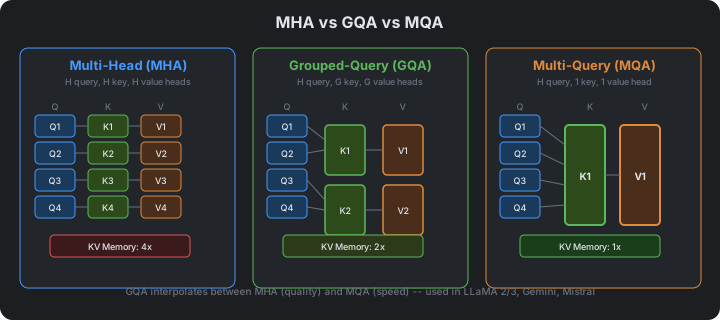
Shazeer (2019) proposed a simple but effective solution: use a single key head and a single value head shared across all query heads.
In standard Multi-Head Attention:
- Q: -- each query head has its own projection
- K: -- each key head has its own projection
- V: -- each value head has its own projection
In Multi-Query Attention:
- Q: -- unchanged
- K: -- single shared key head
- V: -- single shared value head
The KV-cache is reduced by a factor of (e.g., 64x for LLaMA 2 70B). For our earlier example, this drops the cache from 85 GB to about 1.3 GB.
However, MQA can degrade model quality because all query heads are forced to share the same key-value representation. This is a significant information bottleneck.
Grouped-Query Attention (Ainslie et al., 2023)
GQA strikes a middle ground: instead of sharing one KV head across all query heads, it shares one KV head across a group of query heads. With query heads and KV heads, each KV head serves a group of query heads.
| Method | Query Heads | KV Heads | KV Cache Reduction | Quality |
|---|---|---|---|---|
| MHA | 1x (baseline) | Best | ||
| GQA | (where ) | x | Near-MHA | |
| MQA | 1 | x | Slight degradation |
Typical configurations in practice:
| Model | Query Heads | KV Heads | Group Size | KV Cache Reduction |
|---|---|---|---|---|
| LLaMA 2 7B | 32 | 32 | 1 (MHA) | 1x |
| LLaMA 2 70B | 64 | 8 | 8 | 8x |
| Mistral 7B | 32 | 8 | 4 | 4x |
| LLaMA 3 8B | 32 | 8 | 4 | 4x |
| LLaMA 3 70B | 64 | 8 | 8 | 8x |
GQA Implementation
import torch
import torch.nn as nn
import torch.nn.functional as F
import math


class GroupedQueryAttention(nn.Module):
    """Grouped-Query Attention as used in LLaMA 2/3 and Mistral.

    Supports MHA (n_kv_heads == n_heads), GQA (1 < n_kv_heads < n_heads),
    and MQA (n_kv_heads == 1) as special cases.
    """

    def __init__(
        self,
        d_model: int,
        n_heads: int,
        n_kv_heads: int,
        max_seq_len: int = 4096,
        rope_theta: float = 10000.0
    ):
        super().__init__()
        assert n_heads % n_kv_heads == 0, \
            f"n_heads ({n_heads}) must be divisible by n_kv_heads ({n_kv_heads})"

        self.n_heads = n_heads
        self.n_kv_heads = n_kv_heads
        self.n_groups = n_heads // n_kv_heads
        self.head_dim = d_model // n_heads

        # Separate projections for Q (full heads) and KV (reduced heads)
        self.wq = nn.Linear(d_model, n_heads * self.head_dim, bias=False)
        self.wk = nn.Linear(d_model, n_kv_heads * self.head_dim, bias=False)
        self.wv = nn.Linear(d_model, n_kv_heads * self.head_dim, bias=False)
        self.wo = nn.Linear(n_heads * self.head_dim, d_model, bias=False)

        # Precompute RoPE frequencies
        self.register_buffer(
            "freqs_cis",
            precompute_freqs_cis(self.head_dim, max_seq_len, rope_theta),
            persistent=False
        )

    def forward(
        self,
        x: torch.Tensor,
        start_pos: int = 0,
        mask: torch.Tensor | None = None
    ) -> torch.Tensor:
        B, T, _ = x.shape

        # Project to queries, keys, values
        q = self.wq(x).view(B, T, self.n_heads, self.head_dim)
        k = self.wk(x).view(B, T, self.n_kv_heads, self.head_dim)
        v = self.wv(x).view(B, T, self.n_kv_heads, self.head_dim)

        # Apply RoPE to queries and keys
        freqs = self.freqs_cis[start_pos : start_pos + T]
        q, k = apply_rotary_emb(q, k, freqs)

        # Expand KV heads to match query heads
        # (B, T, n_kv_heads, head_dim) -> (B, T, n_heads, head_dim)
        k = self._repeat_kv(k)
        v = self._repeat_kv(v)

        # Transpose for attention: (B, n_heads, T, head_dim)
        q = q.transpose(1, 2)
        k = k.transpose(1, 2)
        v = v.transpose(1, 2)

        # Scaled dot-product attention
        scale = self.head_dim ** -0.5
        scores = (q @ k.transpose(-2, -1)) * scale

        if mask is not None:
            scores = scores + mask

        attn_weights = F.softmax(scores, dim=-1, dtype=torch.float32)
        attn_weights = attn_weights.type_as(q)

        # Apply attention to values
        output = attn_weights @ v  # (B, n_heads, T, head_dim)
        output = output.transpose(1, 2).contiguous().view(B, T, -1)

        return self.wo(output)

    def _repeat_kv(self, x: torch.Tensor) -> torch.Tensor:
        """Repeat KV heads to match the number of query heads.

        (B, T, n_kv_heads, head_dim) -> (B, T, n_heads, head_dim)
        """
        if self.n_groups == 1:
            return x  # MHA: no repetition needed
        return x.repeat_interleave(self.n_groups, dim=2)
A few implementation notes:
-
repeat_interleavevsexpand: Usingrepeat_interleaveexplicitly copies the data, which is simpler but uses more memory. An alternative isexpand+reshape, which creates a view without copying. For training this difference matters; for inference with KV-cache, the repeated keys/values are computed once. -
Softmax in float32: The softmax is computed in float32 even if the inputs are bfloat16. This prevents numerical issues with large attention scores and is a standard practice in all production implementations.
-
RoPE is applied before KV expansion: The rotation is applied to the KV heads, not the expanded heads. This is both correct (each KV head has its own rotation) and efficient (fewer operations).
3. FlashAttention: IO-Aware Attention
The Memory Bandwidth Problem
Standard attention computes the full attention matrix, writes it to GPU high-bandwidth memory (HBM), then reads it back to compute the output. On modern GPUs, this memory traffic is the bottleneck -- not the floating-point arithmetic.
To understand why, consider the GPU memory hierarchy:
| Memory Level | Capacity | Bandwidth | Latency |
|---|---|---|---|
| Registers | ~256 KB per SM | N/A | 0 cycles |
| SRAM (shared memory) | ~20 MB total | ~19 TB/s | ~5 cycles |
| HBM (global memory) | 40-80 GB | 2-3.35 TB/s | ~200 cycles |
The ratio of compute to memory bandwidth on an A100 is roughly 156:1 (312 TFLOPS / 2 TB/s). This means for every byte loaded from HBM, we can perform about 156 floating-point operations. Standard attention has an arithmetic intensity far below this threshold -- it is memory-bound.
The standard attention algorithm:
- Compute -- write matrix to HBM
- Compute -- read from HBM, write to HBM
- Compute -- read from HBM, write output to HBM
For sequence length and , the attention matrix alone requires MB in float16 -- per head, per layer. With 32 heads and 32 layers, that is 32 GB of intermediate memory just for one forward pass.
FlashAttention: Tiling and Online Softmax
Dao et al. (2022) introduced FlashAttention, which never materializes the full attention matrix. Instead, it computes attention in tiles that fit entirely in SRAM, performing the full attention computation without writing the intermediate or matrices to HBM.
The algorithm relies on two key insights:
Insight 1: Tiling. Divide , , and into blocks of size (for ) and (for , ), chosen so that all intermediate results fit in SRAM. Each tile computes a partial attention output.
Insight 2: Online softmax. The softmax normalization requires the full row of attention scores to compute the denominator . The online softmax trick (Milakov and Gimelshein, 2018) maintains a running maximum and running sum, allowing the softmax to be computed incrementally as new blocks of are processed:
For each new block , update:
This rescaling ensures numerical stability (subtracting the running maximum) and correctness (properly re-weighting partial results as the global normalization constant changes).
FlashAttention Pseudocode
The algorithm in simplified form:
Algorithm: FlashAttention Forward Pass
Input: Q, K, V in HBM, block sizes B_r, B_c

1. Divide Q into blocks Q_1, ..., Q_{T_r} of size B_r x d
2. Divide K, V into blocks K_1,...,K_{T_c}, V_1,...,V_{T_c} of size B_c x d
3. For each query block Q_i (outer loop):
     a. Load Q_i into SRAM
     b. Initialize: O_i = 0, l_i = 0, m_i = -inf
     c. For each KV block (K_j, V_j) (inner loop):
          i.   Load K_j, V_j into SRAM
          ii.  Compute S_ij = Q_i @ K_j^T / sqrt(d)  [in SRAM]
          iii. Compute block max: m_ij = rowmax(S_ij)
          iv.  Update running max: m_new = max(m_i, m_ij)
          v.   Rescale: P_ij = exp(S_ij - m_new)
          vi.  Update: l_new = exp(m_i - m_new) * l_i + rowsum(P_ij)
          vii. Update: O_i = (exp(m_i - m_new) * l_i * O_i + P_ij @ V_j) / l_new
          viii. m_i = m_new, l_i = l_new
     d. Write O_i to HBM
4. Return O
The critical point is that is a small block (e.g., ) that fits in SRAM. It is never written to HBM. The only HBM reads are , , (once each), and the only HBM write is the output .
Performance and Memory Complexity
| Method | HBM Reads/Writes | Memory | Wall-Clock Speed |
|---|---|---|---|
| Standard Attention | reads/writes | for attention matrix | Baseline |
| FlashAttention | reads/writes* | -- no attention matrix stored | 2-4x faster |
| FlashAttention-2 | Same asymptotic | ~2x faster than FA-1 | |
| FlashAttention-3 | Same asymptotic | Further gains on Hopper GPUs |
* is SRAM size. The IO complexity is optimal in the sense that no algorithm can achieve fewer HBM accesses.
FlashAttention-2 and -3
FlashAttention-2 (Dao, 2023) improved on the original with:
- Parallelizing over the sequence length dimension (outer loop over Q blocks) instead of batch/heads
- Reducing non-matmul FLOPs (warp shuffles, shared memory reads)
- Better work partitioning across warps within a thread block
FlashAttention-3 (Dao et al., 2024) targets NVIDIA Hopper (H100) GPUs with:
- Asynchronous data movement using TMA (Tensor Memory Accelerator)
- Warp specialization: different warps handle memory operations vs compute
- FP8 quantization support for further speedups
Using FlashAttention in Practice
PyTorch 2.0+ integrates FlashAttention into scaled_dot_product_attention:
import torch
import torch.nn.functional as F


# PyTorch automatically selects the best attention backend:
# - FlashAttention (for supported dtypes and GPU architectures)
# - Memory-efficient attention (xformers-style)
# - Standard math attention (fallback)
def efficient_attention(
    q: torch.Tensor,
    k: torch.Tensor,
    v: torch.Tensor,
    is_causal: bool = True
) -> torch.Tensor:
    """Compute attention using PyTorch's SDPA with automatic backend selection.

    Args:
        q: (batch, n_heads, seq_len, head_dim)
        k: (batch, n_kv_heads, seq_len, head_dim)
        v: (batch, n_kv_heads, seq_len, head_dim)
        is_causal: Whether to apply causal masking.

    Returns:
        Output tensor of shape (batch, n_heads, seq_len, head_dim).
    """
    # For GQA: expand KV heads to match query heads
    if k.shape[1] != q.shape[1]:
        n_groups = q.shape[1] // k.shape[1]
        k = k.repeat_interleave(n_groups, dim=1)
        v = v.repeat_interleave(n_groups, dim=1)

    return F.scaled_dot_product_attention(
        q, k, v,
        attn_mask=None,
        dropout_p=0.0,
        is_causal=is_causal
    )
You can verify which backend is being used:
# Check available backends
from torch.backends.cuda import (
    flash_sdp_enabled,
    mem_efficient_sdp_enabled
)

print(f"FlashAttention available: {flash_sdp_enabled()}")
print(f"Memory-efficient attention available: {mem_efficient_sdp_enabled()}")
4. Sliding Window Attention
Motivation
Even with FlashAttention's memory, the compute cost of attention remains in FLOPs. For very long sequences (100K+ tokens), this quadratic cost becomes significant. Sliding window attention limits each token's attention to a fixed window of previous tokens, reducing the compute to .
How It Works
Instead of allowing each token to attend to all previous tokens, sliding window attention restricts the attention span:
where denotes the keys within the window .
For a window size and sequence length :
| Property | Full Attention | Sliding Window |
|---|---|---|
| Attention span per token | All previous tokens | previous tokens |
| FLOPs per layer | ||
| KV-cache size | Grows with | Fixed at |
| Effective receptive field | per layer | across layers |
The key insight for the effective receptive field: with a window size and layers, information can propagate up to tokens through the residual connections. Mistral 7B uses with 32 layers, giving an effective receptive field of 131,072 tokens despite each layer only attending to 4,096 tokens.
Implementation Considerations
Sliding window attention is efficiently supported by FlashAttention-2 and later versions. The causal mask is modified to zero out attention scores outside the window:
During inference with a KV-cache, the cache only needs to store the last tokens, making the memory usage constant regardless of the total sequence length. This is particularly valuable for long-context inference.
Models Using Sliding Window Attention
| Model | Window Size | Layers | Effective Receptive Field |
|---|---|---|---|
| Mistral 7B | 4,096 | 32 | 131,072 |
| Mixtral 8x7B | 4,096 | 32 | 131,072 |
| Gemma 2 (alternating) | Mix of local and global | 42 | Full context |
Gemma 2 uses an interesting hybrid: alternating layers of sliding window attention (for efficiency) and full global attention (for long-range dependencies). This gives the best of both worlds.
Summary
| Innovation | Problem Solved | Mechanism | Adopted By |
|---|---|---|---|
| RoPE | Position encoding with extrapolation | Rotation in complex plane | LLaMA, Mistral, Qwen, Gemma |
| GQA | KV-cache memory during inference | Shared KV heads across query groups | LLaMA 2/3, Mistral |
| FlashAttention | Memory bandwidth bottleneck | Tiling + online softmax in SRAM | Nearly all modern LLMs |
| Sliding Window | Quadratic complexity for long sequences | Fixed-size attention window per layer | Mistral, Gemma 2 |
These modifications are complementary and are typically used together. A modern LLM like LLaMA 3 or Mistral combines RoPE for position encoding, GQA for KV-cache efficiency, and FlashAttention for IO-aware computation -- all within a Pre-LN decoder-only architecture with RMSNorm.
In the next post, we will turn to Part 4: FFN Modifications -- the evolution of the feed-forward network from simple ReLU MLPs to gated architectures like SwiGLU, and how Mixture of Experts (MoE) enables scaling to trillion-parameter models while keeping inference costs manageable.
References
- Vaswani, A., Shazeer, N., Parmar, N., et al. (2017). "Attention Is All You Need." NeurIPS 2017.
- Su, J., Lu, Y., Pan, S., Murtadha, A., Wen, B., Liu, Y. (2021). "RoFormer: Enhanced Transformer with Rotary Position Embedding." arXiv:2104.09864.
- Shazeer, N. (2019). "Fast Transformer Decoding: One Write-Head is All You Need." arXiv:1911.02150.
- Ainslie, J., Lee-Thorp, J., de Jong, M., Zemlyanskiy, Y., Lebron, F., Sanghai, S. (2023). "GQA: Training Generalized Multi-Query Transformer Models from Multi-Head Checkpoints." EMNLP 2023.
- Dao, T., Fu, D. Y., Ermon, S., Rudra, A., Re, C. (2022). "FlashAttention: Fast and Memory-Efficient Exact Attention with IO-Awareness." NeurIPS 2022.
- Dao, T. (2023). "FlashAttention-2: Faster Attention with Better Parallelism and Work Partitioning." arXiv:2307.08691.
- Press, O., Smith, N. A., Lewis, M. (2022). "Train Short, Test Long: Attention with Linear Biases Enables Input Length Extrapolation." ICLR 2022.
- Chen, S., Wong, S., Chen, L., Tian, Y. (2023). "Extending Context Window of Large Language Models via Position Interpolation." arXiv:2306.15595.
- Jiang, A. Q., Sablayrolles, A., Mensch, A., et al. (2023). "Mistral 7B." arXiv:2310.06825.
- Milakov, M. and Gimelshein, N. (2018). "Online Normalizer Calculation for Softmax." arXiv:1805.02867.
Written by Suchinthaka Wanninayaka
AI/ML Researcher exploring semantic communications, diffusion models, and language model systems. Writing about deep learning from theory to production.
Continue the Series
Transformer Deep Dive: Part 2 - Architecture Changes
17 min read
Next ArticleTransformer Deep Dive: Part 4 - FFN Modifications
22 min read
Related Articles
Diffusion Deep Dive Part 1: From an Impossible Integral to a Two-Line Loss (and Back Out to Samples)
22 min read
Diffusion Deep Dive Part 2: DDIM — From 1000 Steps to 25 Without Retraining
11 min read
Diffusion Deep Dive Part 3: Coding a DDPM from Scratch
22 min read
Responses
No responses yet. Be the first to share your thoughts!